Spade Farm
New
How-to guide
No two weeks on a dairy look the same. You rebalance the ration, regroup a pen, bring on a new milker. Meanwhile the bunker composition changes, the weather turns, and a number drifts without anyone touching it. Every one of those shows up in your data eventually. The question is whether you can connect the change to the number while it still matters.
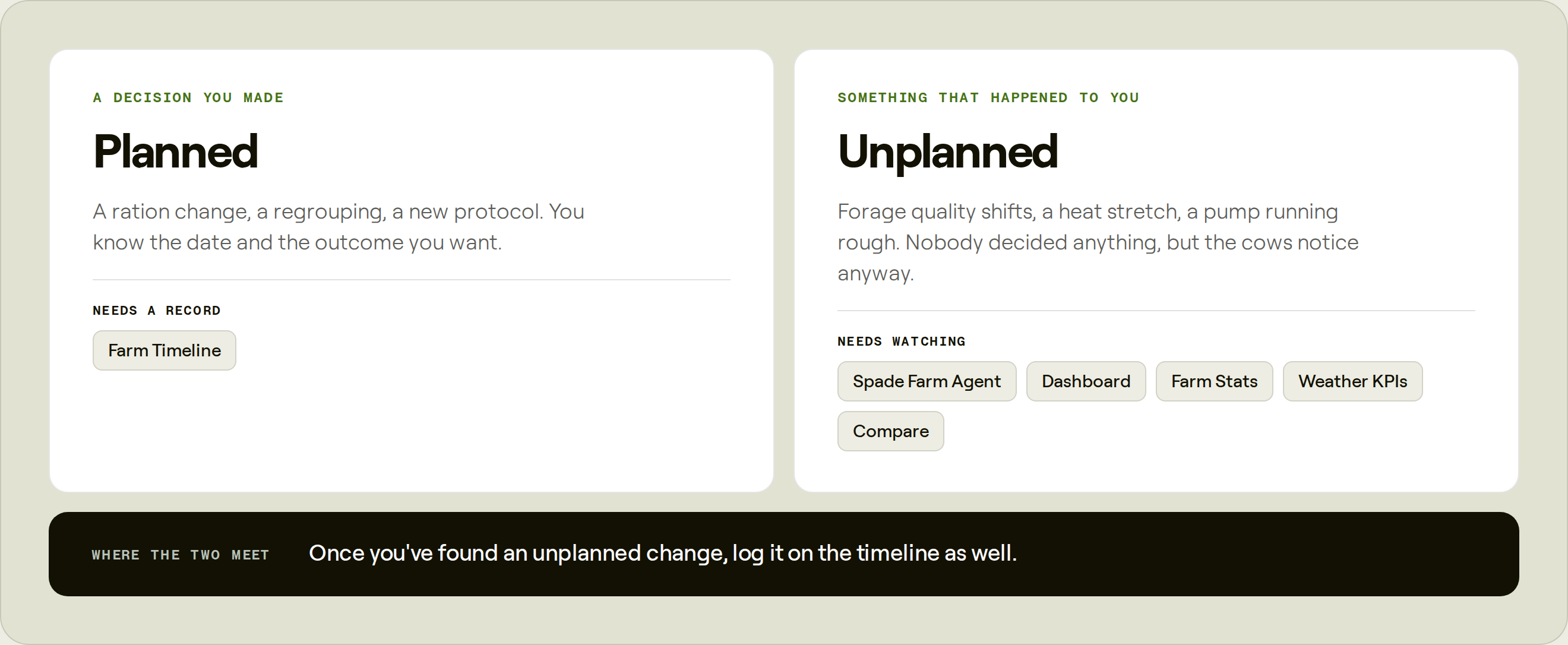
Change on a dairy comes in two kinds: planned (a decision you made) and unplanned (something that happened to you)
Planned changes need a record. Log what you changed and when, so you can check later whether it did what you wanted
Unplanned changes need watching. You can only react to a shift you can see, and the Spade Farm Agent can do the watching for you, summarizing what moved so you don't have to dig through every number yourself
The two meet in the middle: once you've found an unplanned change, log it too. That's how a bad week becomes something the farm learns from
Spade Farm handles both. Farm Timeline is the record. The Spade Farm Agent, the daily Dashboard, Farm Stats and Compare are how you watch
Every change on a dairy falls into one of two buckets.
Planned changes are decisions. You raise the energy in the ration to push milk. You regroup fresh cows. You start a new hoof care protocol. You made the call, you know the date, and you have an outcome in mind.
Unplanned changes are the ones that find you. Forage quality shifts as you move through the bunker. A heat stretch settles in. A pump starts running rough. Nobody decided anything, but the cows notice anyway.
Each kind needs a different habit. Planned changes need a record. Unplanned changes need monitoring. Most farms do some of both, but only loosely, and that's where good decisions get lost.
Every planned change is a small experiment. You're betting that the new ration, grouping or protocol will beat the old one. The only way to know if the bet paid off is to compare what happened against what you expected, and you can't do that if nobody remembers when the change went in.
This is more common than anyone likes to admit. Ask what changed on the dairy six weeks ago and you'll get a confident answer that's off by a week or so. By the time milk is down two pounds and the nutritionist asks what's different, the record lives in three people's memories and a text thread.
The fix is simple: log the change when you make it. Date, what you did, which cows it touched. Then, a couple of weeks later, look at the numbers that change should have moved.
How Spade Farm does it
weeks
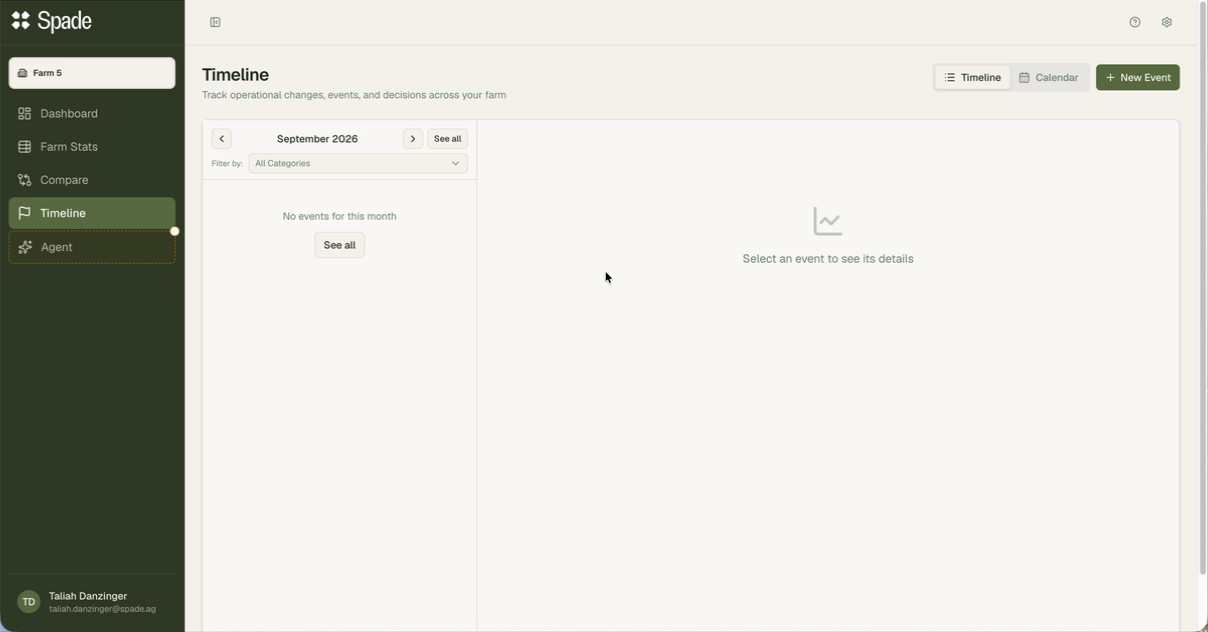
Farm Timeline is a running log of every operational change on your dairy, with the numbers next to it.
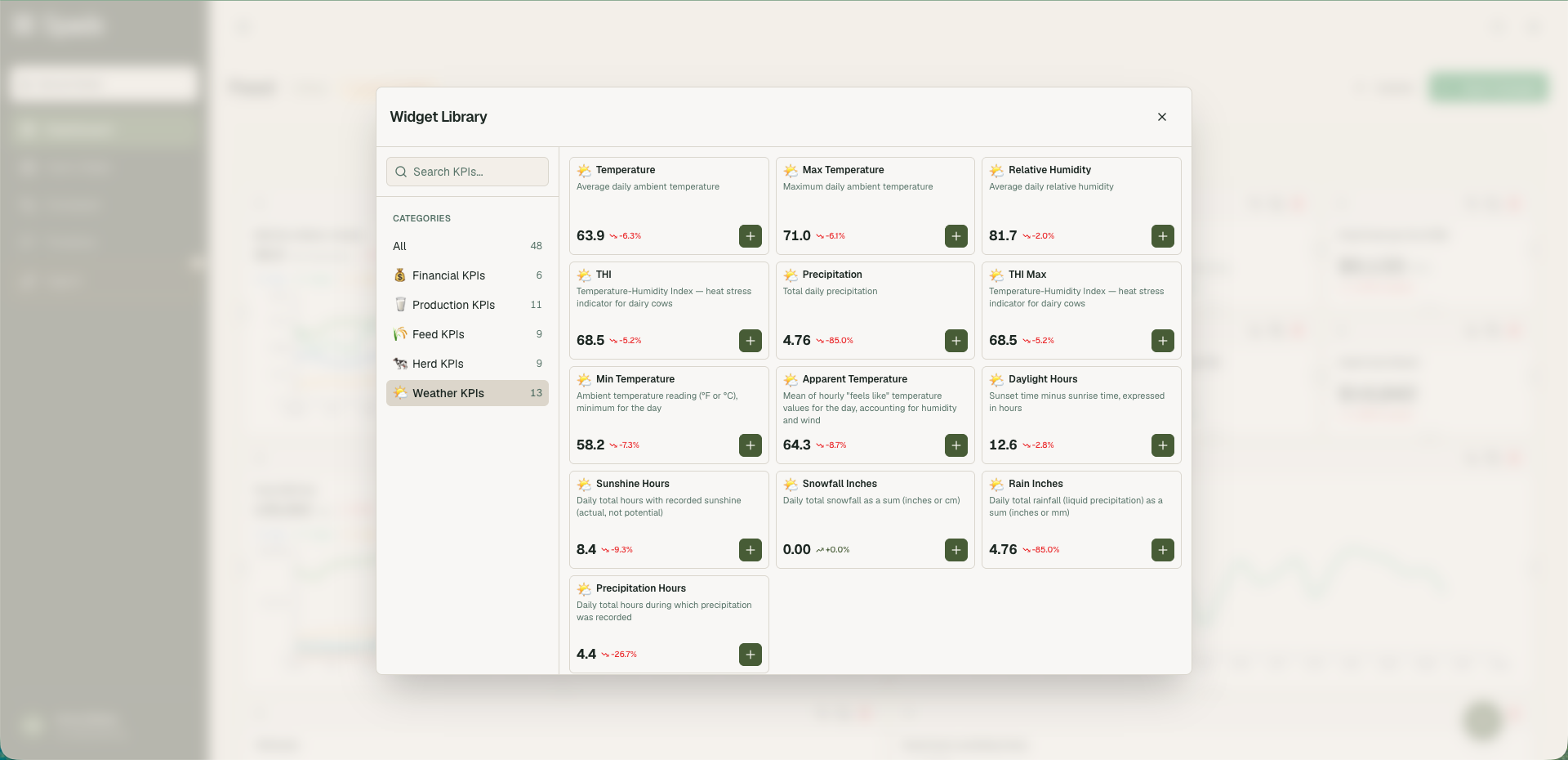
Add any other KPI you want from the catalog of feed, herd, production, financial and weather metrics. If you think a mixer maintenance upgrade touched components, put milk fat on the same screen.
One honest caveat: a before-and-after view shows you what moved around your change. It doesn't prove your change caused it. Weather, stage of lactation and a dozen other things move at the same time. What a timeline does give you is a short list of suspects, which beats guessing across a whole farm’s worth of changes.
You can't log an unplanned change in advance, so the job is to spot it fast. That means someone, or something, has to watch a short list of core numbers every day, so a shift stands out while it's still small.
Take the bunker. Nutrient content can vary a lot from the face to the center. Hit a stretch of wetter or less digestible silage and production slips. If you're checking dry matter intake and production daily, you see the dip within a day or two and can trace it back to the feed. If you're checking monthly, you find it on the milk check.
Weather works the same way. Intake responds to heat stress within a day or two. Cell count and conception take weeks to show it, and by then the heat is long gone and nobody connects the two.
How Spade Farm does it
weeks
Here's the step most farms skip. Once you've found an unplanned change, log it on the timeline as well.
The bad section of silage, the week the fans went down, the flooded lot, the day the parlor lost a unit. Backdate it to when it started and give it a category. Now it sits alongside everything you did on purpose, and the next time the numbers move, you're choosing between everything that actually happened, not just the changes you planned.
Over a season, this is how a farm builds its own memory, and it's the memory the Spade Farm Agent works from. The agent reads your timeline. So when you ask why milk dropped last week, it looks at more than the numbers. It can see that you opened a new bunker on Tuesday and expanded the fresh pen on Thursday, and line those events up against what moved. Every event you log makes its answers sharper. One event is an anecdote. A year of logged changes, planned and unplanned, is close to your own evidence base, and it doesn't walk out the door when a herd manager does.
You don't need a new process. You need three small habits.
Ration changes, protocol adjustments, staffing. Thirty seconds each.
Intake, milk, components, SCC, and weather when it's hot. You're looking for anything that broke from its usual range. Your agent can be an extra set of eyes: ask it for a summary of what moved, or save a daily check as a skill and run it with one tap.
ideally with your nutritionist or herd manager. What changed, what moved, and what needs a closer look? Filter by category and the agenda builds itself.
A planned change is a decision you made, like a ration adjustment or a regrouping. An unplanned change comes from outside, like shifts in forage quality, weather or equipment. Planned changes need a record; unplanned ones need daily monitoring.
Start with dry matter intake, milk per cow, components and somatic cell count. Add THI during hot weather. Those catch most feed, health and environmental shifts early. Or ask the Spade Farm Agent to summarize what moved.
Yes. Farm Timeline lets you backdate events, so you can log a bad load of silage or a heat event after you've found it. Many farms start by entering the changes they remember from the last few months.
No. It shows what moved around the time of the change. Use it to narrow down what to look at, and if the decision is expensive, test it properly with comparable groups.
Yes. The agent reads your Farm Timeline events, so when it explains why a number moved, it can point to the changes you logged around the same time. The more you log, the more useful its answers get.